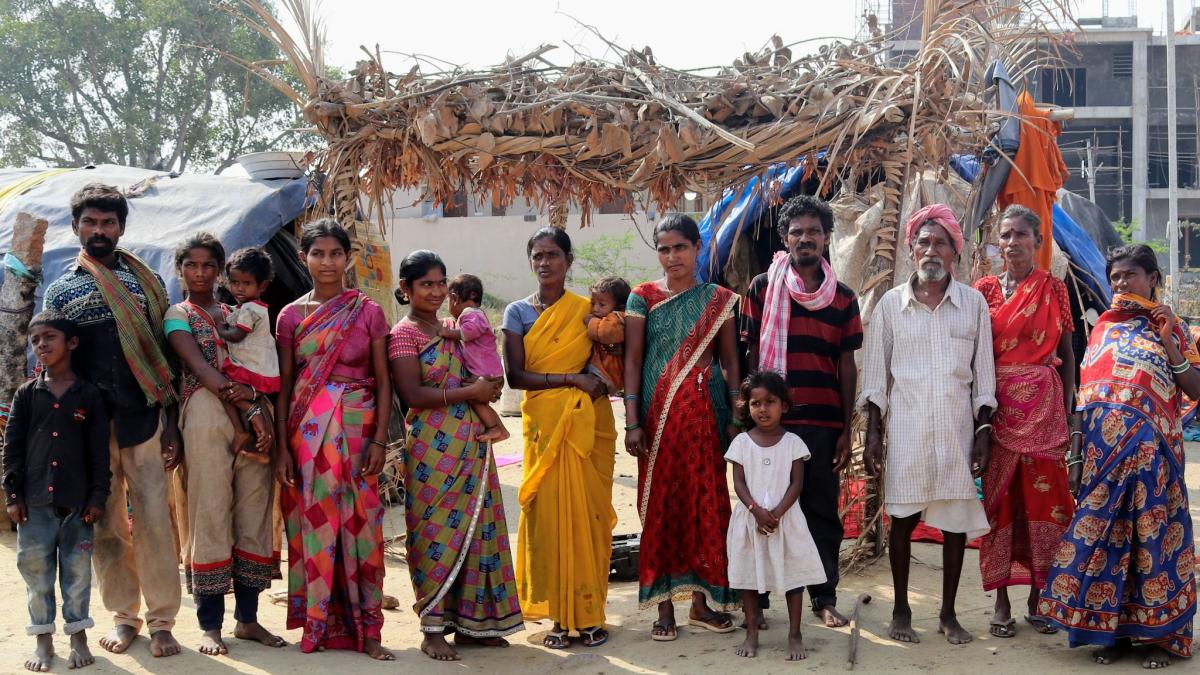
Skill Development for Tribals People
Skills Development refers to the process of acquiring, improving, and enhancing a wide range of skills and competencies.
ABOUT TRIBAL PEOPLES:
A tribe is a group of people who live and work together in a shared geographical area. A tribe has a common culture, dialect, and religion. They also have a strong sense of unity. The tribe is usually headed by a chief.
-
Tribes, usually two to three generations live together in small settlements or villages. Most families of tribes are related to one another and groups of such families form a tribe. Members of a tribe follow occupations such as hunting, gathering, farming, herding and fishing.
-
Tribal people are the groups of people who live in their native lands which have been passed down to them for many generations. The groups will be big or small compared to their living conditions and the turmoils they have gone through. Tribal people usually live in forest areas and consume products as their food.

-
Tribes were communities that did not practise a religion with a written text; did not have a state or political form of the normal kind; did not have sharp class divisions; and, most important, they did not have caste and were neither Hindus nor peasants.
-
A tribe history is an Indian group which possesses certain qualities and characteristics that make it a unique cultural, social, and political entity. The nature of what constitutes an Indian tribe and the very nature of tribes have changed considerably over the course of centuries, but certain characteristics have remained.
-
The ethnic people of India have played a vital role in preserving bio-diversity of several virgin forests and have conserved several flora and fauna in sacred groves of tribals, otherwise these flora and fauna might have been disappeared from natural eco -system.

-
Tribal life is characterized by comparative physical and cultural isolation, simplicity, small group size, low population density and closeness to nature, both physically and conceptually.
-
A tribe is a group of people who live together, share the same language, culture and history and stay outside towns or cities. Forest products and the land is the source of their livelihood. So it’s called tribe people.
-
Tribe is a very general title for human groups who are based on blood relationships and they can be almost any number. It is considered as a tribe.

Largest tribal group in India:

The tribal culture in tribal society, some men are regarded as leaders, they may be old and experienced or young, brave warriors or priests. Old women are respected for their wisdom and experience. - Tribes have rich and unique cultural traditions, including their own language, music, stories and paintings.
-
Bhil is the largest tribal group in India as per 2021 Census. They constitute approximately 8.6 % of the total scheduled tribal population of India. Bhil tribes are found in the states of Maharashtra, Chhattisgarh, Gujarat, Rajasthan, Madhya Pradesh, as well as in Tripura. The language spoken by this tribe is Bhil.
-
Bhills are considered as one of the oldest tribe in India. Once they were the ruler in parts of Rajasthan, Gujarat, Malwa, Madhya Pradesh and Bihar. They are a cross section of great Munda race and a wild tribe of India.
-
It was formerly common to refer to the Indigenous peoples of the Americas, Africa, and elsewhere as tribes: the Yoruba tribe, the Mohawk tribe, tribes of the Amazon jungle.
-
The Tribes of India are Gonds, Bhils (or Bheels), Santhal, Munda, Khasi, Garo, Angami, Bhutia, Chenchu, Kodaba, and the Great Andamanese Tribes. Of all these tribes, the Bhil tribal group, as per the 2011 census, is the largest tribe in India.
Changes of Tribal Societies:

Indian history has witnessed various changes in society. Most of it encompasses the caste system followed religiously in our society. Apart from the social structure in the cities, there were other societies that flourished on the sidelines known as tribal societies.
These tribal societies were usually groups of people who had kinship bonds. These tribes were mostly involved in primary activities related to agriculture or animal husbandry. Some of them are also hunter-gatherers. Out of these tribal societies few tribes were also Nomadic.
This meant that these tribes or groups of people move from one place to another and search for livelihood or other reasons. The settled tribal groups on the other hand had land and animals which they owned jointly as a tribe. The Tribe leader divided the animals and lands according to the needs and requirements of his people.
These tribes were spread all across the country. Most of the tribes lived in forest Hills desert and far-fetched places. There are even shreds of evidence of tribal clashes amongst themselves as well as societies of other religions. The tribes continue to keep their freedom and culture separate from the rest of us. On one hand, they kept their societies separate from us but on the other hand, they were also dependent on us for their needs. We also traded in many handmade articles and wares from them. This led to a gradual change in both societies.
Modern Tribal Society:
Varna-based society and culture and tribal people have constantly interacted with each other. This interaction has caused both kinds of cultures and societies to adapt and change. There were a number of different tribes, and they took on a wide range of livelihoods.
Over a span of years, many of them merged into a caste-based society. Others, however, have rejected both the caste system and conservative Hinduism. Some tribes have established extensive provinces with well-organized systems of government. They have thus become powerful and influential. This pulled them into conflict with larger, more complicated states and empires and evolved into the modern tribal society.


We know the below:
The Khasi, Jaintia, and Garo people practice matrilineality and create one of the largest communities in the world that believes in this system.
Birsa Munda, a revolutionary in the Indian Independence Struggle, originated from the Munda tribe, found primarily in Jharkhand.
The Ghoomar, a folk dance of Rajasthan, was created by the Bhil tribe.
Tribes different from Other People in Society:

Members of the tribe were united by lineage. The tribes earned their livelihood from agricultural activities. Some were hunter-gatherers and herders. The tribes used to combine both activities so that they can make use of the natural resources. Some of the tribes were migratory and moved from one place to another.
Professional of Tribals:
Nomadic pastoralists used to move with their animals to long distances. They used to survive on milk. Most of them traded wool, ghee, and this settled the farmers for grain, cloth, utensils, and other products. These products were traded when they relocated The Banjaras were nomadic traders. The grains were transported in Sultan’san Alauddin Khalji reign
There were many tribs who reared and sold animals like cattle and horses. Even some of the small peddlers also travelled from place to place. These tribes usually sold wares such as ropes, reeds, straw mattresses, and coarse sacks.
The different tribes of India:
In India, a wide variety of tribes are found. India is a big country and has different states. For example, in Punjab, the Khokhar tribe was found in the 13th and 14th centuries. After that, another tribe emerged which was called Gakkhars. In the northwest part of India, the Balochis tribe was found. In the Himalayas, the Shepherd Tribe was the most popular. In the northeastern part of India, many tribes such as Nagas, Ahoms, etc. were popular. Tribes such as Kolis, Beards, etc. were found in Maharashtra and Karnataka. In the southern part of India, large tribes such as Vetars, Maravars, and Koragas were popular.
Modern Tribal Society:

The people belonging to the Varba society and many tribes have communicated with each other and they have exchanged many cultural views. This led to a change in their cultures. Different tribes took over different livelihoods. As time passed, some of them changed into a caste-based society. But, many rejected the caste system as well as the idea of Hinduism. Some tribes live independently as a well-organized system and they have their own rules. They become powerful and influence other people. They had a conflict with large states which led to the formation of modern tribal society.
Schemes & Initiatives for tribal skill development:
-
Pradhan Mantri Kaushal Vikas Yojana (PMKVY)
-
Rozgar Mela.
-
Capacity Building Scheme.
-
Udaan.
-
India International Skill Centres (IISCs)
Healthcare of tribal:
India’s poor tribal people have far worse health indicators than the general population. Most tribal people live in remote rural hamlets in hilly, forested or desert areas where illiteracy, trying physical environments, malnutrition, inadequate access to potable water, and lack of personal hygiene and sanitation make them more vulnerable to disease.
Challenges:
Lack of awareness of health issues
Lack of health facilities in remote rural areas
Lack of emergency transportation
Discriminatory behavior by health care providers

Damooga Foundation
81909 91122
Would you like to share your thoughts?
Your email address will not be published. Required fields are marked *
2 Comments